
WELCOME BONUS 300%
UP TO €2000 + 100
FREE SPINS
UP TO €2000 + 100
FREE SPINS
Home → Blackjack
Blackjack at Myjackpot Casino: Variants, Rules and Payouts
Error insurance: 7 percent additional house edge
The Blackjack Insurance side bet carries a steep house edge of 7.47 percent, which drastically reduces the theoretical return to player. This high cost is due to the fact that the insurance wager only pays out at a 2:1 ratio when the dealer holds a ten-value card. Consequently, players who accept this optional wager lose money significantly faster than those who decline it entirely.
In contrast, the main Blackjack game offers much better odds, with the Liberal Vegas Strip variant boasting an RTP of 99.72 percent. The insurance bet alone drops the overall expected value down to 92.53 percent, making it one of the worst wagers available on any table. Beginners should strictly avoid this option unless they are counting cards and the true count reaches plus three.
The difference in expected loss between playing without insurance and taking it is substantial for anyone betting large amounts over time. A standard deviation of 1.15 indicates moderate volatility in the base game, but adding insurance introduces unnecessary risk. Players aiming to preserve their bankroll must reject the dealer's offer whenever an Ace appears up.
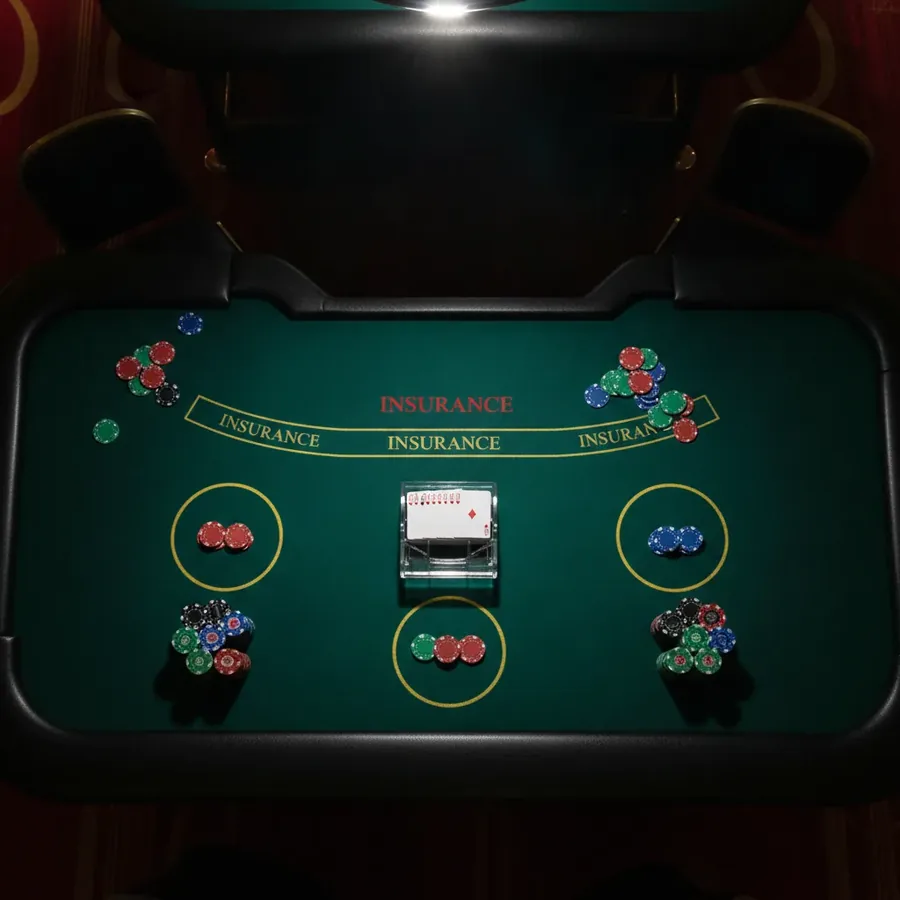
Seat change at the Live Table in 20 seconds
Infinite Blackjack by Evolution allows unlimited players to join the virtual felt, ensuring that finding an open seat takes mere seconds rather than minutes. The software interface handles seat assignment automatically, allowing newcomers to start betting immediately without waiting for others to finish their hands. This efficiency is crucial for maintaining the flow of the game during peak hours.
Lightning Blackjack also supports unlimited participation while adding multipliers up to 25x on winning hands, creating a dynamic environment for fast-paced action. The maximum bet limit of 2,500 EUR accommodates high rollers who want to move quickly between stakes or tables. The seamless transition between rounds ensures that no time is wasted on administrative delays.
Infinity Blackjack sets a higher stake ceiling of 5,000 EUR, providing ample room for aggressive strategies without hitting table limits too soon. The four available side bets, including Any Pair and Bust It, add variety without slowing down the primary gameplay loop. Players can switch focus between these options rapidly, keeping the session engaging and efficient.
Insurance vs Even Money on Own Blackjack
When a player holds a natural Blackjack and the dealer shows an Ace, the casino often offers even money as a guaranteed payout of 1:1. This side deal is mathematically identical to taking insurance on your own hand, as both actions secure half the potential win regardless of the outcome. Accepting this offer locks in a fixed return instead of risking the full 3:2 payoff.
The standard payout for a natural Blackjack is 3:2, meaning a 100 EUR bet yields 150 EUR in profit if the dealer does not also have Blackjack. Taking even money reduces this potential gain to just 100 EUR, effectively surrendering the extra 50 EUR probability-weighted value. Over thousands of hands, this choice significantly erodes the player's long-term expected value.
Rejecting even money preserves the higher RTP associated with the 3:2 rule, which is critical for minimizing the house edge in variants like Liberal Vegas Strip. The 0.28 percent house advantage relies heavily on paying naturals correctly, so altering this payment structure hurts the player. Beginners should always decline these offers to maintain optimal strategic alignment.
What a Natural Blackjack Practically Pays Out
A natural Blackjack consisting of an Ace and a ten-value card typically pays out at a ratio of 3:2 in most reputable online casino games. This means that for every 100 EUR wagered on a winning hand, the player receives 150 EUR in total returns, including the original stake. This favorable rate is a cornerstone of low-house-edge strategies found in games like 6 Decks S17.
Some tables unfortunately offer a reduced 6:5 payout structure, which drastically cuts the winnings to only 120 EUR for the same 100 EUR bet. This seemingly small change increases the house edge by exactly 1.39 percentage points, making the game significantly more expensive to play over time. The difference between 150 EUR and 120 EUR highlights the importance of checking paytables before sitting down.
The RTP for games paying 3:2 remains high, such as the 99.85 percent seen in single-deck classics, whereas 6:5 variants drop to around 98.15 percent. This disparity underscores why beginners must actively seek out 3:2 tables to maximize their theoretical returns. Choosing the wrong payout structure can double the cost of entertainment per hour played.
Step-by-step Split at the Live Table
Splitting pairs is a fundamental strategy in Blackjack that allows players to divide matching cards into two separate hands, each requiring an additional bet equal to the original. In games offering Double After Split, players can further enhance their position by doubling down on either new hand after receiving one card. This flexibility significantly improves the expected value compared to rigid splitting rules.
The DAS feature, or Double After Split, provides a negative impact of -0.14 percentage points on the house edge, making it a highly desirable rule for players. Resplitting Aces, which adds another -0.08 percentage points, allows for even more strategic depth by letting players re-split if they receive another Ace. These combined benefits make liberal rule sets far superior to restrictive ones.
Infinite Blackjack and Lightning Blackjack both support these advanced splitting mechanics, allowing unlimited participants to execute complex strategies simultaneously without delay. The ability to split and double freely aligns with the basic strategy required for optimal play in 6 Deck S17 variants. Mastering these steps helps minimize losses and maximizes the utility of every chip placed.
Blackjack variants at a glance
| Variant | Payout | House edge | Rule | Bet range |
|---|---|---|---|---|
| Blackjack Surrender (Late Surrender) – Regel-Effekt | n.a. (Regel-Modifikator) | −0.08 Prozentpunkte | Spieler gibt Hand nach Dealer-Blackjack-Prüfung auf, verliert die Hälfte des Einsatzes. Verbessert RTP um ca. 0.08 Prozentpunkte. Early Surrender ist wesentlich wertvoller (bis −0.6 Prozentpunkte), aber extrem selten. | Rückzahlung 50% des Einsatzes |
| Blackjack Ein Deck, klassische Regeln, 3:2 | 99.85% | 0.15% | Weniger Decks = niedrigerer Vorteil; ein Deck gibt ca. −0.48 Prozentpunkte gegenüber 8 Decks. Oft durch 6:5 Auszahlung kompensiert. | Blackjack 3:2, Gewinn 1:1 |
| Blackjack Auszahlung 6:5 statt 3:2 (6 Decks) | 98.15% | 1.85% | Ersatz von 3:2 durch 6:5 fügt exakt +1.39 Prozentpunkte zum Vorteil des Casinos hinzu – stärker als jede andere Regeländerung. Bei $10 Einsatz zahlt Blackjack $12 statt $15. | Blackjack 6:5, Gewinn 1:1 |
| Blackjack Liberal Vegas Strip (liberale Regeln, 3:2) | 99.72% | 0.28% | Günstigste Regelkombination: S17 + DAS + Resplit + Late Surrender. Standardabweichung 1,15 | Blackjack 3:2, Gewinn 1:1 |
| Blackjack Split / Double / H17 – Regel-Effekte | n.a. (Regel-Modifikatoren) | H17 +0.22 Prozentpunkte; RSA −0.08 Prozentpunkte; DAS −0.14 Prozentpunkte | Dealer Hits Soft 17 verschlechtert RTP um 0.22 Prozentpunkte; Resplit Aces verbessert um 0.08 Prozentpunkte; Double After Split verbessert um ca. 0.14 Prozentpunkte; 6 Decks statt 8 – ca. 0.02 Prozentpunkte. | Double – Einsatz ×2 mit einer Karte; Split – bis 4 Hände; Ass-Split meist mit einer Karte. |
| Blackjack Insurance / Versicherung (6–8 Decks) | 92.53% | 7.47% | Separate Nebenwette bis 50% der Hauptwette, wenn der Dealer ein Ass hat. Basisstrategie schreibt IMMER Ablehnung vor (außer Karten zählen bei True Count ≥ +3). Bei einem Deck Vorteil ≈ 5.88% | Insurance 2:1 |
Statistics display saves the last 100 rounds
The game interface retains a history of the previous 100 rounds for each session. This finite window prevents players from tracking long-term variance or relying on streaks that do not exist in random number generation. Players should recognize this limit when analyzing recent outcomes to avoid cognitive biases.
Evolution provides Lightning Blackjack with a maximum multiplier of 25x on winning hands. The Infinite Blackjack variant offers a higher betting range, accepting stakes up to 5,000 EUR per hand. These distinct limits define the potential volatility and maximum exposure for high-roller strategies.
Blackjack Party features two live moderators who manage the pace of the game table. The betting limits for this specific title range from 1.00 EUR to 1,000 EUR. This narrower ceiling distinguishes it from the standard Infinite tables which allow significantly larger wagers.
Shoe, Cut Card, and 75 Percent Penetration
Standard online blackjack uses six decks to determine the initial house edge parameters. The dealer typically cuts the shoe at approximately 75 percent penetration before reshuffling the cards. This procedure ensures fairness by limiting the predictability of card composition for advantage players.
Lightning Blackjack operates with an RTP of 99.56% despite its unique multiplier mechanics. The Infinite version maintains a slightly lower theoretical return of 99.47%. Both titles utilize continuous shuffling or large deck shoes to maintain the stated penetration rates.
Early surrender is extremely rare in modern online implementations compared to late surrender rules. The absence of early surrender removes a powerful tool that could reduce the house edge by up to 0.6 percentage points. Players must accept the standard late surrender limitation if available.
Side Bets Increase House Edge to 5 Percent
Insurance bets pay 2:1 but carry a house edge of 7.47% in six-deck games. This side wager becomes viable only if the player counts cards and holds a true count of +3 or higher. Standard basic strategy dictates always rejecting insurance under normal conditions.
Infinite Blackjack offers four specific side bets including Any Pair and 21+3. These optional wagers significantly increase the overall house edge beyond the main game limits. The base bet remains competitive at 99.47% RTP, but side bets drain bankrolls faster.
Lightning Blackjack includes multipliers that affect payouts but does not list separate side bet edges. The main game RTP stands at 99.56%, which is among the highest for live dealer titles. Players focusing on low-edge strategies should stick to the primary hand outcome.
Register Late Surrender correctly in three steps
Late surrender allows the player to forfeit half the bet after the dealer checks for blackjack. This rule improves the player's expected return by approximately 0.08 percentage points. It applies only when the dealer does not hold an ace or ten-value card initially.
The payout for a successful surrender is exactly 50% of the original stake returned. This immediate loss mitigation is superior to losing the full amount in a bust scenario. Players must declare surrender before taking any other action like hitting or doubling.
This option is distinct from early surrender which is valued at up to -0.6% edge. Early surrender permits giving up before the dealer checks for blackjack, a much rarer rule. Most online casinos, including those offering late surrender, exclude the more favorable early version entirely.
Double Down vs Simple Hit on 11
Doubling down on an 11 against a dealer weak card maximizes expected value in the long run. The player doubles the initial stake to receive exactly one additional card. This aggressive move exploits the high probability of drawing a ten-value card.
Hit on 11 yields a lower return because the player risks busting or settling on a low total. Doubling restricts the risk to a single card draw while capturing all upside potential. Basic strategy mandates doubling whenever the dealer shows a 2 through 9.
Resplitting aces improves the return by 0.08 percentage points compared to restricted splitting rules. Some variants allow doubling after split, adding another 0.14 percentage points of value. These modifiers make liberal rule sets significantly more profitable than restrictive ones.
Card Counting at Shuffle Master Table: why it fails
The Blackjack Insurance side bet offers a distinct mathematical trap for beginners relying on complex counting systems. This separate wager pays 2:1 if the dealer holds an Ace, but requires a True Count of at least +3 to be viable. The house edge jumps to 7.47% when using six to eight decks, making consistent profit nearly impossible. Players must always reject this bet unless they possess advanced card tracking skills.
Shuffle Master tables typically utilize between six and eight decks, which drastically dilutes the effectiveness of any counting strategy. A single deck might offer a lower advantage of approximately 5.88%, but multi-deck shoes prevent accurate tracking. The frequent shuffling ensures that the true count never reaches the necessary threshold for profitable insurance bets. Beginners often lose money quickly by ignoring this structural limitation in modern casino environments.
Even skilled players face significant barriers because the insurance rule mandates rejection under standard basic strategy conditions. The requirement for a high True Count means most hands result in a net loss for the gambler. This specific mechanic ensures that the casino retains its statistical edge regardless of player skill level. The complexity of calculating counts across multiple decks makes this approach fundamentally flawed for casual enthusiasts.
One Deck vs Eight Decks in House Edge
Blackjack with one deck provides a superior RTP of 99.85% compared to the 99.54% found in six-deck games. This single-deck variant reduces the house edge to just 0.15%, offering better long-term value for players. Fewer cards in play significantly lower the casino's mathematical advantage over the participant. Beginners should prioritize these tables whenever available to maximize their potential returns.
However, the six-deck version still maintains a competitive edge at 0.46% with S17 and DAS rules. Each additional deck adds friction to the game, slightly increasing the cost of play for everyone. The difference between one and six decks highlights the importance of table selection.
Rule variations like hitting soft 17 add another 0.22 percentage points to the house advantage in multi-deck scenarios. Resplitting aces improves odds by 0.08 percentage points, while doubling after split adds 0.14 percentage points. These modifiers interact with the deck count to determine the final theoretical return. Understanding these interactions helps players identify the most favorable conditions for their bankroll management strategies.
The classic single-deck game often compensates for its low edge with restrictive rules like 6:5 payouts. Such changes can negate the benefits of fewer decks entirely, raising the edge to 1.85%. Players must verify payout structures before sitting down to ensure the advertised RTP is accurate. Always check the specific terms attached to the single-deck offering to avoid unexpected losses.
Four hours of play with 300 EUR bankroll
A 300 EUR bankroll allows for sustained play across four hours if stakes remain conservative and low. Standard blackjack tables often start at minimum bets that fit within this budget without rapid depletion. Using basic strategy minimizes variance, ensuring the bankroll lasts longer than random betting patterns would allow. This duration provides ample time to learn table dynamics without risking financial ruin immediately.
Lightning Blackjack offers limits from 1 to 2,500 EUR, allowing small bets that preserve capital during extended sessions. Infinite Blackjack ranges from 1 to 5,000 EUR, providing flexibility for players wishing to adjust wagers slowly. These wide ranges enable participants to manage their 300 EUR effectively by sticking to the lower end. Consistent low-stakes play reduces the impact of inevitable losing streaks on the total balance.
Slot contributions to bonus turnover are set at 100%, whereas table games contribute only 10%, affecting bonus eligibility. Playing blackjack for four hours generates minimal bonus progress compared to spinning slot machines. This discrepancy means players seeking free spins or deposit matches should allocate more time to slots instead. Table gaming remains excellent for entertainment but inefficient for clearing wagering requirements quickly.
The welcome bonus structure includes 100 free spins alongside the monetary match, which slots can activate faster. Since table games lag behind in contributing to turnover, combining them with slots might optimize bonus usage. However, mixing games can complicate tracking of remaining wagering obligations for inexperienced users. Sticking to one game type simplifies monitoring progress toward unlocking withdrawn funds legally.
What Percentage Does Blackjack Count Towards Bonus?
Blackjack contributes exactly 10% toward the bonus wagering requirement, significantly less than the 100% allocated to slots. This disparity forces players to wager ten times more on tables to clear the same bonus amount as slots. For example, a 300 EUR bonus requires 30,000 EUR in table bets versus 3,000 EUR in slots. Understanding this ratio is crucial for managing expectations during the clearance process.
The 300% welcome bonus up to 2,000 EUR becomes extremely costly to clear through blackjack alone. Reaching the maximum bonus of 2,000 EUR demands 20,000 EUR in total table wagers due to the 10% contribution rate. This high turnover volume increases exposure to the house edge, potentially eroding the initial deposit before withdrawal. Players must weigh the effort against the actual value gained from such extensive play.
Infinite Blackjack allows bets up to 5,000 EUR per round, accelerating turnover accumulation despite the low contribution percentage. High rollers might clear bonuses faster by placing larger stakes at tables like Lightning Blackjack or Party variants. However, the risk of depleting the bankroll before meeting requirements remains substantial for average players. Careful stake sizing is essential to balance speed of clearance with financial safety margins.
Side bets in live games do not typically contribute to main bonus turnover, further complicating the calculation for players. Focusing solely on base game hands ensures compliance with terms while avoiding invalid wagers. Tracking progress manually is necessary since automatic deduction does not apply to non-contributing actions. Transparency in tracking tools helps players stay informed about their remaining obligation status accurately.
Splitting tens costs expected value: better stand
Basic strategy strictly advises standing on pairs of tens rather than splitting them, preserving the strong hand value of twenty. Splitting creates two hands starting with ten, each facing a high probability of busting or receiving weak cards. The expected value drops significantly when breaking a natural twenty into two weaker positions. Maintaining the original hand maximizes winning chances against dealer upcards ranging from two to nine.
Resplitting aces improves odds by 0.08 percentage points, demonstrating how specific rules can enhance player outcomes. However, applying similar logic to tens ignores the fundamental weakness of starting new hands with ten. Unlike aces, tens are vulnerable to drawing cards that push totals over twenty-one easily. Strategic discipline requires resisting the urge to split strong combinations based on misconceptions about frequency.
Double After Split (DAS) adds 0.14 percentage points to player advantage, rewarding aggressive play in specific scenarios. Yet, doubling down on newly split tens often leads to suboptimal results compared to standing initially. The mathematical edge favors keeping the original twenty intact rather than gambling on two separate outcomes. Adhering to proven strategies prevents unnecessary losses caused by intuitive but incorrect splitting decisions.
Dealer hitting soft 17 increases the house edge by 0.22 percentage points, making table rules critical for success. Players who split tens ignore these subtle shifts in advantage that favor conservative play. Recognizing the impact of rule variations helps refine strategy beyond simple memorization of splits. Always consult updated charts that account for current table conditions before making irreversible betting choices.
Contact
Live - online chat
Banking









Providers












Myjackpot Casino 2026